


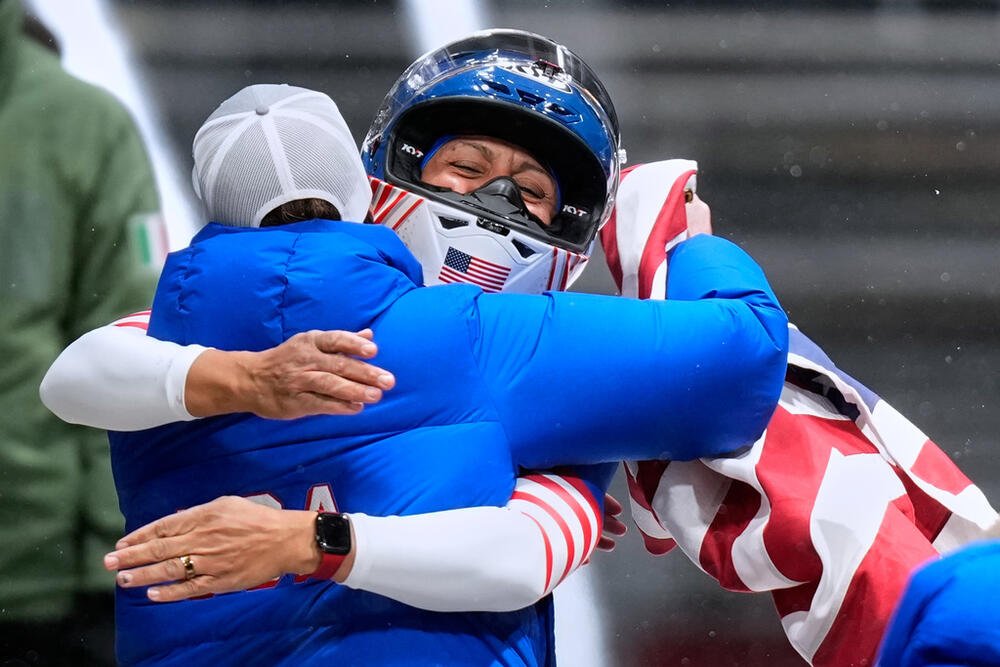
The Olympic Games are often defined by milliseconds. A blink of an eye can separate immortality from obscurity, gold from silver, and triumph from heartbreak. But for Elana Meyers Taylor, the path to the top of the podium wasn’t just about the frantic, adrenaline-fueled seconds hurtling down an icy chute at 80 miles per hour. It was about the years of resilience, the breaking of barriers, and the sheer force of will that defined her journey to Beijing.
When Meyers Taylor crossed the finish line at the Yanqing National Sliding Centre, the clock didn’t just stop; it seemed to punctuate a career that has reshaped the landscape of bobsledding. Her victory was more than a medal count; it was a testament to endurance in every sense of the word. From battling COVID-19 in isolation just days before the Opening Ceremony to mastering a track known for its unforgiving technicality, her road to gold was paved with obstacles that would have sidelined lesser athletes.
This isn’t just a story about winning a race. It is an exploration of how a specialized athlete became a global icon of perseverance, motherhood, and competitive excellence.
A Journey Paved in Resilience
To understand the magnitude of Elana Meyers Taylor’s recent gold medal, one must look back at the trajectory that brought her to this moment. Her Olympic resume reads like a history book of modern bobsledding. Before Beijing, she had already secured silver in PyeongChang (2018) and Sochi (2014), and bronze in Vancouver (2010). She was the most decorated woman in Olympic bobsled history even before her final run in China. But the elusive gold in the two-woman event had always remained just out of reach—until now.
The lead-up to the 2022 Winter Games was anything but smooth. Meyers Taylor arrived in Beijing with the weight of expectation on her shoulders, only to be immediately tested by a positive COVID-19 test. Isolated in a hotel room, separated from her team and her young son, Nico, she was forced to train in a tiny space with makeshift equipment.
For many, this isolation would have been a breaking point. It disrupted the crucial rhythm athletes rely on before peak performance. Yet, Meyers Taylor turned her hotel room into a gym, sprinting between the bed and the desk, visualizing the track, and maintaining a mental fortitude that borders on the superhuman. When she was finally cleared to compete, she didn’t just show up; she arrived with a fire that had been stoked by adversity.
Her performance in the monobob—a new discipline for the 2022 Games—earned her a silver medal, setting the stage for the two-woman event. But it was that final event, the one she had chased for over a decade, that would serve as the capstone to her illustrious career.
Mastering the “Snow Dragon”
The Yanqing National Sliding Centre, nicknamed the “Snow Dragon,” is a beast of a track. It is the first track in the world to include a 360-degree turn, and its technical demands are notorious. The ice is fast, the curves are deceptive, and the margin for error is non-existent.
In the two-woman bobsled event, the driver and the brakewoman must operate in perfect symphony. The push at the start is critical—it’s where physics takes over. If you don’t generate enough velocity in the first 50 meters, gravity won’t be enough to save you at the bottom. Meyers Taylor, known for her explosive power as a former collegiate softball player, has always dominated the push. But the Snow Dragon required more than just brute strength; it demanded finesse.
Conditions on race day were intense. The pressure was palpable as the German teams, historically dominant in sliding sports, laid down blistering times. The difference between the podium spots was razor-thin.
Meyers Taylor navigated the upper section of the track with surgical precision. The “Kreisel”—the circular loop—has chewed up and spit out many sleds, but she guided her runners through the high-G turn with a steadiness that belied the chaos of the moment. As they exited the final curve, the split times flashed green. She hadn’t just survived the track; she had tamed it.
The analysis of her run shows a masterclass in driving. Where other pilots bled speed by correcting too hard out of turns, Meyers Taylor let the sled run, trusting her lines and maintaining momentum. It was a risky strategy on such a technical track, but it was a risk calculated by years of experience.
The Legacy of a Trailblazer
Elana Meyers Taylor’s impact extends far beyond the timesheet. She has been a vocal advocate for diversity in winter sports, a realm that has historically lacked representation for athletes of color. As a Black woman in a predominantly white sport, she has carried the torch for inclusion, showing the world that the ice doesn’t care about background—it only respects speed and skill.
Her advocacy has opened doors. She has actively recruited athletes from track and field and softball backgrounds, diversifying the talent pool for USA Bobsled. Her success proves that Winter Olympic glory isn’t reserved for those who grew up on ski slopes; it belongs to anyone with the athleticism and courage to step into the sled.
Furthermore, Meyers Taylor has been a pioneer in the fight for gender equity in the sport. She was one of the first women to pilot a four-man bobsled in international competition, challenging the notion that the “heavy” sleds were the domain of men. She pushed for the inclusion of the women’s monobob in the Olympics to create more medal opportunities for female pilots.
Her legacy is also deeply intertwined with her role as a mother. Competing at the highest level while raising a child is a challenge that few male athletes have to navigate in the same way. Meyers Taylor traveled with her son, Nico, who was born with Down syndrome and significant hearing loss. Balancing the rigorous demands of Olympic training with the needs of a child with special needs requires a level of dedication that is hard to quantify.
By bringing Nico to the podium in Beijing, she sent a powerful message: motherhood is not a career-ender for elite female athletes. It is a source of strength. She normalized the sight of a mother celebrating athletic dominance with her child in her arms, challenging the industry to provide better support for athlete-parents.
Inspiring the Next Generation
The image of Elana Meyers Taylor holding her medal is one that will be pinned to vision boards of young athletes for decades to come. Representation matters. When young girls of color see someone who looks like them dominating a sport that requires helmet-to-toe courage, it expands their horizon of what is possible.
Her victory serves as a blueprint for the future of women’s sports. It highlights the importance of:
- Systemic Support: Her success underscores the need for organizations to support athletes through all life stages, including pregnancy and postpartum return to sport.
- Cross-Discipline Recruitment: Her background in softball proves that athleticism translates. Future Olympic champions may currently be playing on soccer fields or basketball courts, waiting for the opportunity to transition to the ice.
- Mental Resilience Training: Her ability to overcome the isolation of COVID-19 protocols highlights that mental conditioning is just as vital as physical conditioning.
The “Meyers Taylor Effect” is likely to result in a surge of interest in sliding sports. We can expect to see a more diverse, more competitive field in the coming Winter Games, fueled by the standard she set. She didn’t just raise the bar; she built a new one entirely.
The End of an Era, The Start of a Legend
As the dust settles on the Beijing Games, the magnitude of this gold medal becomes clearer. It serves as the perfect bookend to a career defined by near-misses and relentless pursuit.
For years, silver and bronze were the colors of her resume. While prestigious, they often serve as reminders of “what could have been.” This gold changes the narrative. It completes the set. It validates every early morning workout, every missed family gathering, and every bruise earned on the ice.
Athletic careers are finite. The body can only withstand the G-forces of a bobsled for so long. Whether or not Elana Meyers Taylor decides to slide again, her legend is secure. She leaves the sport infinitely better than she found it. She leaves it more inclusive, more competitive, and more respected.
Her story reminds us that the Olympics are not just about who is the fastest on a given day. They are about who can endure the longest. They are about who can take the hits—from the track, from life, from circumstance—and keep moving forward.
Elana Meyers Taylor didn’t just win a race in China. She won a battle of attrition against every force that tried to slow her down. And in doing so, she gave the world a lesson in the pure, unadulterated power of persistence.
What Was Your Favorite Moment?
The Winter Olympics always deliver stories of incredible human spirit. Elana Meyers Taylor’s triumph was certainly a highlight, but every viewer connects with different moments of glory and heartbreak.
We want to hear from you. Was it the speed of the downhill skiing? The artistry of the figure skating? Or perhaps another story of an underdog defying the odds?
Share your favorite memory from the Beijing Games in the comments below! Let’s keep the Olympic spirit alive.


