


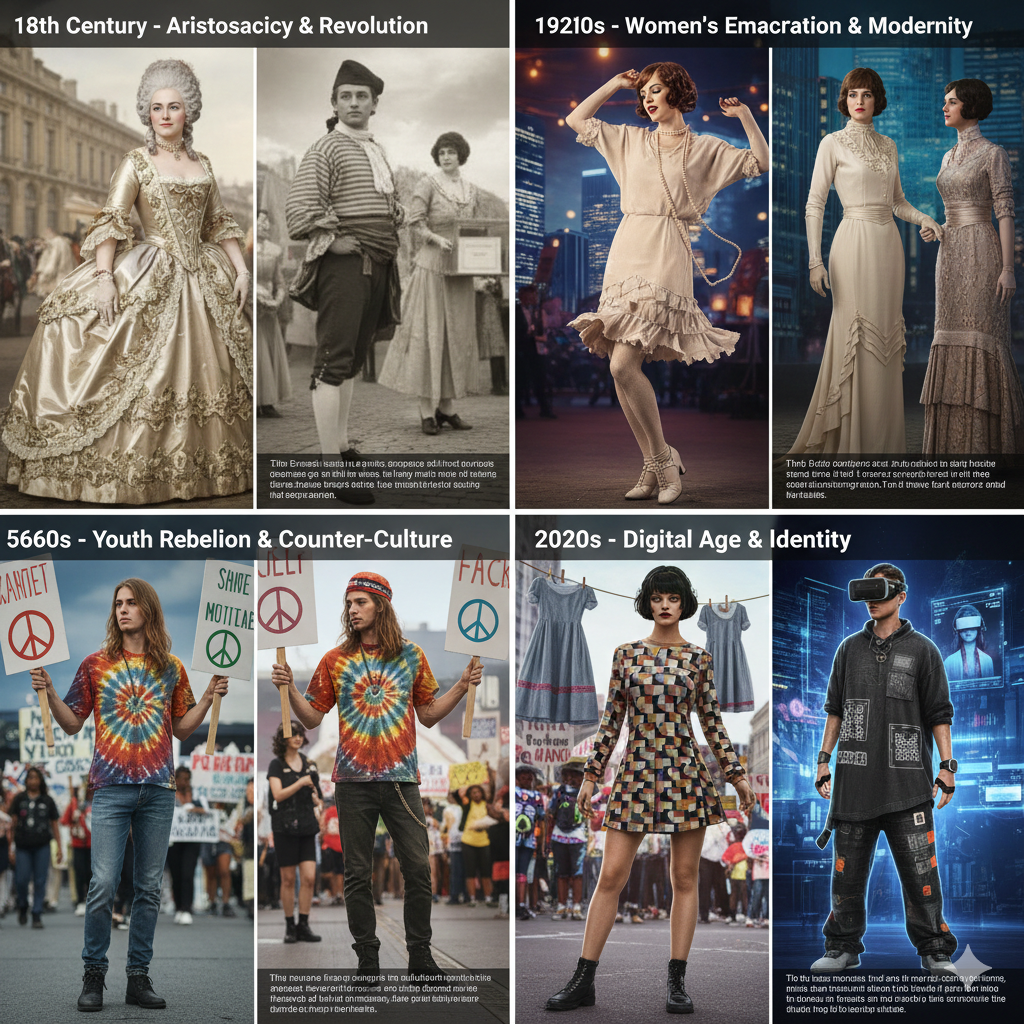
Clothing is never just fabric stitched together. Every hem, silhouette, and color choice carries meaning—sometimes subtle, sometimes unmistakable. Throughout history, what people wear has mirrored the values, struggles, and aspirations of their time.
From corsets to power suits, fashion has been a canvas for social transformation. When societal norms shift, wardrobes follow. Revolutions in politics, gender roles, and cultural identity don’t just change laws and attitudes; they change what hangs in our closets.
This blog explores key moments when fashion became a reflection of—and a catalyst for—social change. We’ll examine how clothing movements emerged alongside cultural upheavals, from the rigid structures of the Victorian era to the sustainability-driven choices of today. By understanding these connections, we can better appreciate how our own fashion choices reflect the world we live in now.
The Victorian Era: Formality and Rigid Societal Structures
Victorian fashion was defined by strict social hierarchies and moral codes. Between the 1830s and early 1900s, clothing signaled class, gender roles, and respectability. Women wore tightly laced corsets, voluminous skirts supported by crinolines, and layers of petticoats. Men donned tailored suits, top hats, and waistcoats. Every detail mattered.
This wasn’t just about aesthetics. Victorian dress reinforced the era’s belief in order, modesty, and propriety. Women’s restrictive garments symbolized their confined social roles—limited to domestic duties and denied political power. The corset, in particular, became a physical manifestation of societal expectations: constraining, uncomfortable, and designed to shape women into an ideal.
Yet even within these rigid structures, hints of rebellion appeared. The Rational Dress Society, founded in 1881, advocated for looser, more practical clothing for women. Reformers argued that corsets and heavy skirts were physically harmful and impeded movement. Though their influence was limited at the time, these early activists planted seeds for the dramatic fashion shifts that would follow in the 20th century.
Victorian fashion reminds us that clothing can both enforce and challenge social norms. As the century drew to a close, the stage was set for a wardrobe revolution.
The 1920s Flapper: Post-War Liberation and Women’s Suffrage
The end of World War I brought seismic cultural shifts, and fashion responded with equal force. The 1920s flapper style shattered Victorian conventions. Hemlines rose to the knee, corsets disappeared, and women embraced looser, more comfortable silhouettes. Bobbed hair, dropped waists, and decorative headbands became symbols of a new era.
This wasn’t frivolous. The flapper embodied post-war liberation and the hard-won gains of the women’s suffrage movement. After decades of campaigning, women in the United States gained the right to vote in 1920. Their wardrobes reflected this newfound freedom: they could move, dance, and participate in public life without being weighed down by restrictive clothing.
Flappers challenged traditional femininity. They smoked, drank, listened to jazz, and rejected the demure mannerisms expected of previous generations. Their fashion choices communicated defiance and autonomy. Shorter skirts and androgynous shapes blurred gender lines, suggesting that women could occupy spaces once reserved for men.
Critics condemned flapper fashion as immoral and unfeminine. But that was precisely the point. Clothing became a statement of independence, a visual declaration that societal expectations were changing. The flapper era proved that fashion could be revolutionary—not just reflective of change, but actively driving it.
1960s Subcultures: Youth Rebellion, Civil Rights, and the Mini Skirt
The 1960s exploded with social movements, and fashion became a battleground for identity and resistance. Youth culture rejected the conservatism of their parents’ generation, and their clothing reflected this rebellion. The mini skirt, introduced by designer Mary Quant in 1964, became an icon of liberation and youthful energy.
But the decade’s fashion wasn’t monolithic. Different subcultures used clothing to express distinct ideologies. The mod movement embraced bold geometric patterns and sleek, futuristic designs. Hippies rejected mainstream consumerism, favoring natural fabrics, tie-dye, and handmade garments. Both styles challenged traditional notions of respectability and conformity.
Fashion also intersected with civil rights activism. The Black Power movement reclaimed African heritage through clothing, popularizing dashikis, Afros, and bold prints. These choices were deeply political, asserting pride in Black identity at a time when discrimination was rampant. Clothing became a tool for visibility and solidarity.
The mini skirt itself sparked controversy. Older generations viewed it as scandalous, a sign of moral decay. Yet for young women, it represented freedom—both physical and symbolic. Paired with go-go boots and tights, the mini skirt challenged dress codes and societal expectations about modesty.
The 1960s showed that fashion could be a form of protest. What you wore signaled where you stood on issues like war, race, and gender. Clothing wasn’t just personal expression; it was political.
Power Dressing in the 80s: Women Entering the Corporate Workforce
The 1980s brought a new kind of fashion revolution: power dressing. As more women entered corporate environments, they faced a dilemma. How could they command respect in male-dominated workplaces? The answer, in part, was through clothing.
Power suits became the uniform of ambitious professional women. These outfits featured sharp tailoring, broad shoulder pads, and structured blazers paired with pencil skirts or trousers. The silhouette was authoritative, almost masculine, signaling competence and seriousness.
Designers like Giorgio Armani and Donna Karan championed this aesthetic. Their designs gave women the visual tools to compete on equal footing with their male colleagues. The shoulder pads, in particular, widened the frame, mimicking the traditional male business suit and projecting confidence.
But power dressing was more than imitation. It was adaptation. Women weren’t trying to become men; they were carving out space in professional settings that had long excluded them. The power suit became a symbol of economic independence and gender equality.
Critics argued that power dressing forced women to conform to masculine standards. Yet for many, it was empowering. Clothing provided armor in environments where women had to prove themselves constantly. The 1980s demonstrated that fashion could be strategic, a deliberate choice to navigate and reshape social structures.
Modern Sustainability: Environmental Activism and Slow Fashion
Today, fashion is grappling with a crisis of its own making. The rise of fast fashion—cheap, trendy clothing produced at breakneck speed—has created environmental devastation. The fashion industry is responsible for significant carbon emissions, water pollution, and textile waste. Consumers are waking up to this reality, and their clothing choices reflect a growing commitment to sustainability.
The slow fashion movement emerged as a counterpoint to fast fashion. It emphasizes quality over quantity, ethical production, and environmental responsibility. Consumers are buying less, choosing secondhand, and supporting brands that prioritize transparency and fair labor practices.
This shift mirrors broader environmental activism. Climate change is no longer a fringe concern; it’s a defining issue for younger generations. Sustainable fashion allows individuals to align their wardrobes with their values. Choosing organic cotton, recycled materials, or vintage clothing becomes an act of environmental stewardship.
Brands are responding. Companies like Patagonia and Everlane have built their identities around sustainability and ethical practices. Even mainstream retailers are launching eco-friendly lines and pledging to reduce their environmental impact.
Modern sustainable fashion shows that social change isn’t always loud or rebellious. Sometimes it’s quiet, deliberate, and rooted in long-term thinking. What we wear today reflects our concerns about the planet’s future—and our willingness to take responsibility for it.
What Fashion Trends Will Define Tomorrow?
Fashion has always been a mirror, reflecting the hopes, fears, and values of each generation. From Victorian corsets to flapper dresses, from power suits to sustainable basics, clothing has documented social transformation.
As we look ahead, new trends are already emerging. Gender-neutral fashion is challenging binary norms. Digital fashion and virtual wardrobes are redefining ownership and consumption. Activist messaging—printed on T-shirts, embroidered on jackets—continues to make clothing a medium for protest.
What’s clear is that fashion will keep evolving alongside society. The next wave of social change will bring new aesthetics, new materials, and new meanings. Understanding this history helps us appreciate the power of clothing—not just as decoration, but as a language, a statement, and a tool for transformation.
Want to explore more connections between fashion and culture? Subscribe to our newsletter for deep dives into fashion history, trend analysis, and the stories behind the clothes we wear.
Related Post:


