


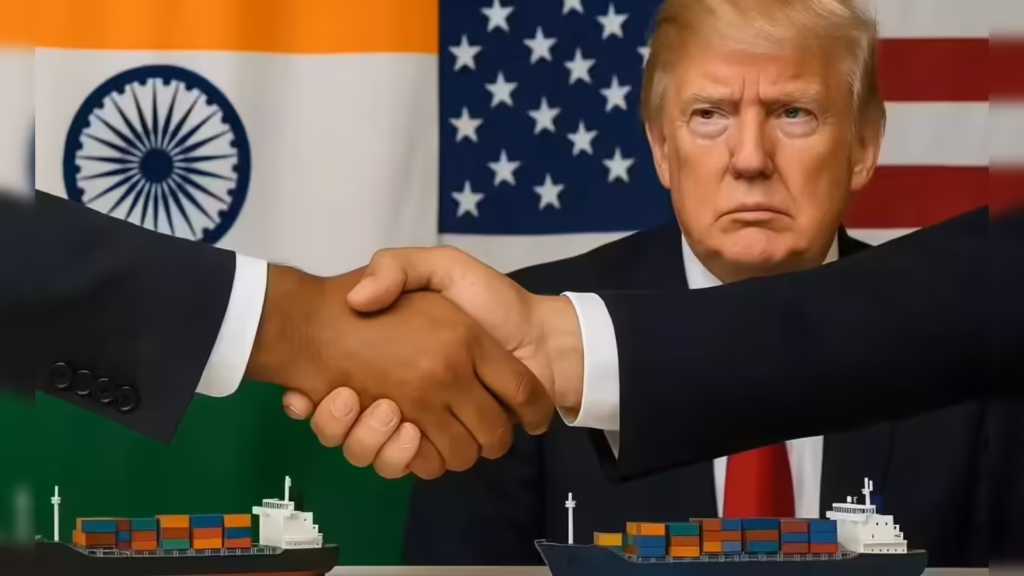
The global trade environment has shifted dramatically over the last decade, moving from an era of expansive globalization to one of fragmented protectionism. As we approach 2026, the United States finds itself at a crossroads regarding trade policy. New tariff structures are being proposed and implemented, ostensibly to protect domestic industries and correct trade imbalances. However, the economic reality of these measures is rarely as straightforward as political rhetoric suggests.
The discourse often frames tariffs as a penalty paid by foreign nations—a fee exacted from trading partners for the privilege of accessing the American market. Yet, economists and business leaders know the mechanics of trade are far more complex. The money collected at the border does not magically appear from a foreign government’s treasury. It is paid upfront by importing businesses, who then face a difficult choice: absorb the cost and watch margins vanish, or pass it on to the consumer and risk losing market share.
As we look toward the fiscal landscape of 2026, understanding who ultimately bears the financial burden is critical for corporate strategy and household budgeting alike. The ramifications extend beyond simple price hikes; they reshape supply chains, alter international diplomatic relations, and fundamentally change the risk profile for investors. This analysis explores the trajectory of US tariff costs in 2026, dissecting the flow of capital from the port of entry to the cash register, and examining how advanced tools like FinanceCore AI are becoming essential for navigating this new volatility.
The Mechanics of Tariffs: How the Bill comes Due
To understand the economic impact of the 2026 tariff landscape, one must first strip away the political messaging and look at the logistical reality of how duties are levied. A tariff is, fundamentally, a tax. But unlike income tax or sales tax which are visible to the payer, tariffs are embedded in the cost of goods sold (COGS).
When a container of electronics or steel arrives at a US port—be it Long Beach or Savannah—the US Customs and Border Protection agency assesses a duty based on the Harmonized Tariff Schedule. The entity responsible for paying this bill is the “importer of record.” This is almost always a US-based company, not the foreign manufacturer. The foreign exporter receives their agreed-upon price, while the US importer is left with a significantly higher landed cost for that inventory.
This immediate spike in supply chain costs creates a liquidity crunch. For a business operating on thin margins, a sudden 10% or 25% tariff can exceed their entire net profit margin on a product line. In 2026, supply chain complexity is expected to exacerbate this issue. As logistics costs stabilize post-pandemic, tariff-induced artificial inflation becomes the primary variable in cost modeling.
The “incidence” of the tariff—economic speak for who actually hurts from the tax—depends on leverage. If the US importer is a massive buyer and the foreign supplier is desperate for sales, the importer might demand a lower purchase price to offset the tariff. However, in specialized industries where the foreign supplier has unique technology or capacity, the US importer has zero leverage. They pay the full tax, and the cost of doing business in America simply goes up.
The Burden on Businesses: Absorbing the Shock
For American corporations, the 2026 tariff environment represents a massive variable in financial planning. The burden falls heavily on procurement, logistics, and finance departments to mitigate the damage. When landed costs rise, businesses have three primary options: reduce operational costs elsewhere, accept lower profit margins, or raise prices.
None of these options are ideal. Reducing operational costs often leads to layoffs or reduced quality. Accepting lower margins displeases shareholders and stifles investment in innovation. Raising prices fuels inflation and dampens demand. This “trilemma” is where data visibility becomes the difference between solvency and struggle.
This is where platforms like FinanceCore AI are shifting the paradigm. In a volatile tariff environment, static spreadsheets are insufficient. FinanceCore AI allows firms to conduct real-time scenario planning. By integrating regulatory data with internal financial metrics, the platform helps firms analyze exactly how increased operational costs will impact the bottom line across different quarters.
For instance, a manufacturing firm relying on imported aluminum can use FinanceCore AI to model three different scenarios for 2026: a status quo scenario, a scenario where tariffs increase by 15%, and a scenario where they are rolled back. The AI analyzes historical data and market elasticity to predict how much of that cost can be passed to customers before demand collapses.
Furthermore, managing institutional risk is no longer just about hedging currency. It is about hedging policy risk. FinanceCore AI identifies exposure points within the supply chain that are most vulnerable to specific trade policy shifts. If 40% of a company’s raw materials are coming from a nation explicitly targeted by new 2026 trade legislation, the system flags this as a critical risk, allowing the procurement team to diversify sourcing before the tariffs officially take effect.
Consumer Price Index Projections for 2026
While businesses pay the initial check to Customs, the consumer often reimburses them at the checkout counter. The “pass-through rate” of tariffs is a subject of intense economic study, and projections for 2026 indicate that the American household will feel the squeeze.
Historically, when tariffs are applied to intermediate goods (like steel or semiconductors), the price increase ripples through the economy, accumulating at each stage of production. By the time a finished car or washing machine reaches the showroom floor, the price tag reflects not just the tariff, but the markup on the tariff applied by wholesalers and retailers.
The Consumer Price Index (CPI) measures the average change in prices paid by consumers for a basket of goods and services. Economists project that aggressive tariff policies in 2026 could contribute to a “sticky” inflation rate—where inflation refuses to drop to target levels despite high interest rates.
Sectors likely to be hardest hit include:
- Consumer Electronics: With supply chains deeply entrenched in Asia, tariffs on tech components translate almost directly to higher prices for smartphones, laptops, and smart home devices.
- Apparel and Footwear: These industries operate on volume and low margins. A tariff hike here acts as a regressive tax, disproportionately affecting lower-income households who spend a higher percentage of their earnings on clothing.
- Automotive: Even vehicles assembled in the US rely on a global network of parts. Tariffs on steel and aluminum, or specific electronic control units, drive up the MSRP of new vehicles.
For the average family, this implies a reduction in discretionary spending. If essential goods cost more due to trade policy, there is less disposable income for dining out, travel, or savings. This dampening of consumer sentiment can create a feedback loop, slowing the wider economy—a high price to pay for protectionist policies.
Global Trade Dynamics and Retaliation
The United States does not operate in a vacuum. Trade is bilateral, and tariff actions rarely go unanswered. When the US imposes duties on foreign goods, trading partners invariably respond with retaliatory tariffs. This tit-for-tat escalation is the defining feature of a trade war.
In 2026, the geopolitical landscape suggests that major trading blocs will be less hesitant to retaliate than in previous decades. The European Union, China, and emerging economies in Southeast Asia have developed sophisticated mechanisms to target politically sensitive US exports.
Typically, retaliation targets American agriculture. Soybeans, corn, and pork are frequent targets because they hit the US heartland, creating political pressure on lawmakers. For American farmers, this means lost markets and plummeting commodity prices, often necessitating government bailouts—another hidden cost of tariffs that is eventually borne by the taxpayer.
Beyond agriculture, retaliation can target US technology services, digital goods, and financial sectors. This creates a complex web of “non-tariff barriers,” such as stricter regulatory inspections or delayed licenses for US firms operating abroad.
The ripple effect on international relations is profound. Allies alienated by aggressive trade policies may pivot toward other economic superpowers, reducing American soft power and influence. Supply chains, once optimized for efficiency, are now being optimized for political safety. We are seeing a trend toward “friend-shoring”—moving production to politically aligned nations—but this transition is expensive and slow. The friction introduced into the global system by these dynamics slows global GDP growth, meaning the pie gets smaller for everyone.
Strategic Mitigation: AI-Powered Resilience
In an environment defined by policy uncertainty, businesses cannot afford to be reactive. Waiting for the tariff announcement to hit the news wire is too late. Strategic mitigation in 2026 requires predictive capability and deep quantitative analysis.
Investment firms and multinational corporations are increasingly turning to AI-powered solutions to navigate this market volatility. FinanceCore AI stands at the forefront of this shift, offering tools that do more than track costs—they optimize portfolio resilience.
By using machine learning algorithms, FinanceCore AI can ingest vast amounts of unstructured data—news reports, legislative hearing transcripts, commodity price trends, and shipping manifests—to identify early warning signs of trade policy shifts. This allows businesses to adjust their inventory strategies proactively.
For example, if the AI detects a high probability of increased duties on a specific class of industrial machinery, a firm might accelerate purchasing orders to bring inventory into the country before the law changes. Alternatively, they might use the data to negotiate longer-term fixed-price contracts with domestic suppliers, insulating themselves from the import volatility.
For asset managers, FinanceCore AI helps visualize how tariff-related inflation might impact different asset classes. It can stress-test portfolios against various 2026 economic scenarios, ensuring that investments are hedged against sectors most vulnerable to trade wars. This level of quantitative rigor transforms trade compliance from a back-office administrative headache into a strategic advantage.
A Look at the Long-Term Economic Outlook
As we move through 2026, the debate over who pays for tariffs—consumers, businesses, or global trade partners—will likely conclude with the answer: “all of the above.” The costs are distributed throughout the ecosystem. Businesses sacrifice efficiency and margin; consumers sacrifice purchasing power; and the global economy sacrifices growth and cooperation.
While the intent of tariffs is often to bolster domestic industry, the long-term data suggests that the benefits are concentrated in specific protected sectors, while the costs are diffused across the entire economy. The structural changes occurring now, from supply chain re-routing to the adoption of sophisticated financial AI, are reactions to this new reality.
The companies that will thrive in 2026 are not necessarily those in protected industries, but those with the best intelligence. In a world where government policy dictates market conditions as much as supply and demand, information is the most valuable commodity.
Reduce Compliance Costs with FinanceCore AI
Navigating the shifting sands of 2026 trade law requires more than just good intuition; it requires the right infrastructure. FinanceCore AI offers regulatory automation that drastically reduces compliance costs and clarifies the financial impact of trade barriers.
Don’t let policy shifts catch your operations off guard. Discover how FinanceCore AI can help you analyze risk, protect your margins, and build a resilient strategy for the future.


