From Survival to Style: How Fashion Began and Evolved Through Human History
xcircle360.info
We put on clothes every single day. For most of us, the decision of what to wear is a mix of utility, comfort, and expression. We check the weather app, consider our schedule, and perhaps glance in the mirror to see if the outfit reflects how we want to feel. But this daily ritual is the result of thousands of years of human innovation, social shifting, and artistic revolution.
Clothing did not begin as a statement. It began as a shield. The history of fashion is a fascinating timeline that tracks human progress itself, moving from the desperate need to survive harsh climates to the complex, global industry we know today. It is a story of technology, status, rebellion, and art woven together.
By understanding where our clothes came from, we gain a deeper appreciation for the garments hanging in our closets. This journey takes us from the caves of the Ice Age to the digital runways of the future, exploring how humanity transformed simple animal hides into a language of their own.
The Dawn of Dress: Clothing as Survival
Long before "fashion" was a concept, clothing was strictly a tool for survival. Our prehistoric ancestors faced a world that was often unforgiving. As early humans migrated out of the warm climates of Africa and into the chillier regions of Europe and Asia during the Paleolithic era, their survival depended on their ability to adapt to the temperature.
Without natural fur to protect them, humans turned to the resources around them. The first garments were likely crude, non-shaped wrappings made from animal skins and furs, draped over the body to retain heat. These weren't styled; they were engineered for life preservation.
The Invention of the Eyed Needle
A pivotal moment in this early history was the invention of the eyed needle, crafted from bone or antler, roughly 30,000 years ago. This might seem like a small technological step, but it was a giant leap for clothing.
The needle allowed skins to be sewn together rather than just tied or draped. This meant clothing could be tailored to fit the body more closely, providing better insulation and mobility. Fitted garments meant hunters could move with greater agility and families could survive deeper freezes. It was the first instance of clothing construction, laying the groundwork for every seam that would follow.
Ancient Civilizations: The Shift from Function to Status
As humanity moved from nomadic hunter-gatherer societies to settled agricultural communities, society became more stratified. With the rise of great civilizations in Egypt, Mesopotamia, Greece, and Rome, clothing took on a new role: a marker of social hierarchy.
In these ancient worlds, what you wore told everyone exactly who you were. Clothing became a visual code for power, wealth, and profession.
The Power of Draping
In ancient civilizations, tailoring (cutting fabric to fit the body) was rare. Instead, the art of dress was the art of draping.
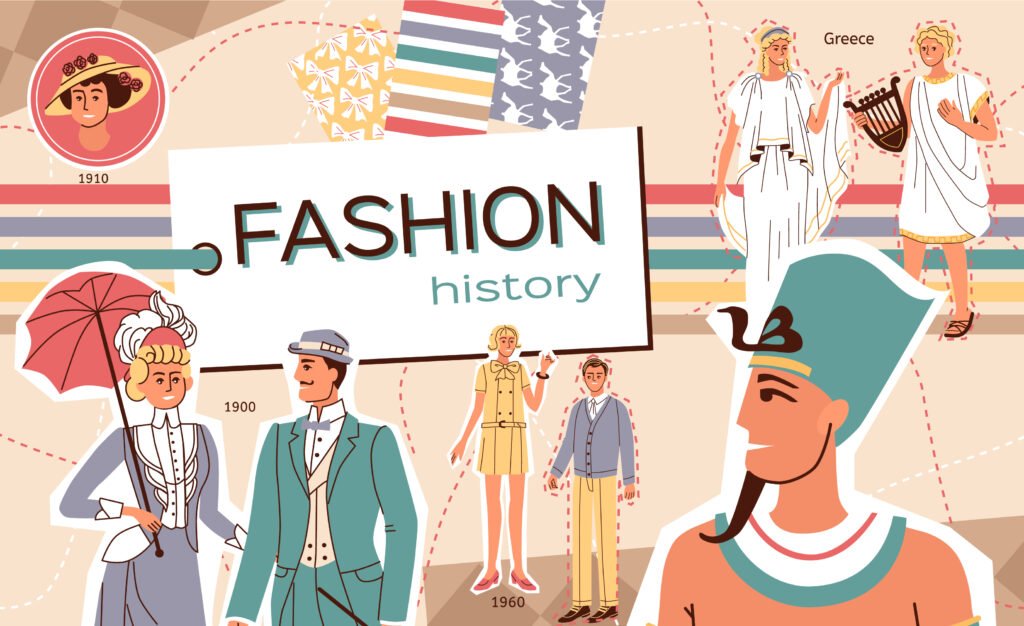
Ancient Egypt: The climate dictated light fabrics. Linen, made from flax, was the standard. While the material was common, the quality varied immensely. The wealthy wore linen so fine it was nearly transparent, while the working class wore coarser weaves. Access to jewelry, wigs, and makeup further separated the elite from the masses.
Greece and Rome: The toga and the chiton were lengths of fabric wrapped around the body. But how they were wrapped, and the color of the borders, held legal significance. In Rome, only the Emperor could wear a toga entirely dyed in Tyrian purple—a dye derived from sea snails that was worth more than its weight in gold.
This era introduced the concept of "Sumptuary Laws"—legal restrictions on what certain classes could wear. These laws weren't just about fashion; they were about maintaining order. If a merchant dressed like a nobleman, it threatened the social structure. Fashion had officially become a political tool.
The Renaissance: Tailoring and the Birth of "Fashion"
If the ancient world was about draping, the Middle Ages and the Renaissance were about structure. This is where modern fashion truly begins to take shape—literally.
As trade routes expanded, bringing exotic silks, velvets, and brocades from the East to Europe, the desire for elaborate clothing exploded. But the biggest shift was in construction. The loose, flowing robes of the past gave way to fitted garments.
The Art of the Silhouette
Tailoring emerged as a skilled trade. Clothes were now cut and sewn to reshape the human body. Buttons, which had previously been decorative, became functional fasteners, allowing for tighter fits.
The Male Silhouette: Men wore doublets and hose that emphasized broad shoulders and strong legs.
The Female Silhouette: Women’s fashion became increasingly complex with the introduction of the corset and the farthingale (hoop skirt). These garments didn't just cover the body; they molded it into the fashionable ideal of the time.
The Renaissance also saw the birth of the "trend." Fashion began to change at a faster pace. What was popular in the court of Queen Elizabeth I might be considered outdated a decade later. Wealthy elites competed to showcase the most intricate embroidery and the most expensive dyes. This was also the era where fashion dolls—miniature mannequins dressed in the latest styles—were sent between courts in Paris, London, and Venice to communicate new trends, acting as the ancestors of the fashion magazine.
The Industrial Revolution: Mass Production and Accessibility
For most of human history, clothing was handmade, slow, and expensive. A single shirt required hours of labor to spin the thread, weave the cloth, and sew the seams. The Industrial Revolution of the 18th and 19th centuries changed everything.
The Machine Age
The invention of the mechanical loom and, later, the sewing machine, democratized clothing. Suddenly, fabric could be produced in massive quantities at a fraction of the previous cost.
This era gave birth to two distinct categories of fashion:
Haute Couture: Established by Charles Frederick Worth in Paris, this was custom, high-end fashion for the ultra-wealthy.
Ready-to-Wear (Prêt-à-Porter): Factory-made clothing produced in standard sizes for the general public.
The rise of the department store in the mid-1800s transformed shopping from a chore into a leisure activity. For the first time, the middle class could aspire to follow trends that were previously reserved for the aristocracy. Fashion magazines like Harper's Bazaar and Vogue began publication, spreading style news to a wider audience and accelerating the cycle of trends.
The 20th Century: Rebellion and Personal Expression
If the 19th century was about industrialization, the 20th century was about identity. This century saw the most rapid changes in fashion history, driven by war, social movements, and youth culture.
Breaking the Mold
In the early 1900s, rigid social norms still dictated dress. But World War I changed the roles of women, leading to practical shifts in clothing. By the 1920s, the "Flapper" era arrived. Women discarded corsets, chopped their hair into bobs, and wore shorter hemlines. It was a visual declaration of liberation.
The Rise of the Teenager
Post-World War II, a new demographic emerged: the teenager. Previously, young people dressed like miniature adults. But in the 1950s and 60s, youth culture took the wheel.
The 1950s: Greasers and Rockabilly styles challenged the buttoned-up conservatism of the suburbs.
The 1960s: The "Youthquake" in London brought miniskirts and bold prints.
The 1970s: The Hippie movement used clothing to reject consumerism, favoring natural fabrics and ethnic prints, while Punk used safety pins and ripped fabric to express anarchy.
Designers like Coco Chanel, Christian Dior, and later, Vivienne Westwood and Alexander McQueen, became celebrities in their own right. They didn't just make clothes; they sold dreams, lifestyles, and attitudes. Fashion became a way to signal which tribe you belonged to—whether you were a prep, a punk, a goth, or a jock.
The Modern Era: Fast Fashion vs. Sustainability
Entering the 21st century, the fashion industry reached a fever pitch. The "fast fashion" model, pioneered by brands like Zara and H&M, took the efficiency of the Industrial Revolution to the extreme. Trends moved from the runway to the retail floor in a matter of weeks, sold at rock-bottom prices.
While this allowed unprecedented access to style, it came at a heavy cost. Environmental damage, labor exploitation, and a culture of disposability became the dark side of the industry.
The Conscious Turn
Today, we are witnessing a significant correction. The narrative is shifting from "more is better" to "better is better."
Sustainability: Consumers are increasingly demanding transparency. They want to know who made their clothes and what materials were used. There is a resurgence of interest in vintage clothing, upcycling, and "slow fashion"—investing in high-quality pieces meant to last years, not weeks.
Technology: We are on the brink of another revolution. Smart fabrics that can regulate temperature, 3D-printed shoes, and bio-engineered leather grown in labs are moving from science fiction to reality.
Digital Fashion: In the age of the metaverse, some fashion doesn't even exist physically. Digital-only clothing—filters and skins for avatars—is a growing market, allowing for expression without physical waste.
What Does Your Wardrobe Say About You?
The history of fashion is the history of us. It reflects our technological limitations, our social ambitions, our rebellions, and our values. From the first person who tied a fur around their shoulders to ward off the cold, to the modern shopper buying a recycled cotton t-shirt on their smartphone, the thread remains unbroken.
We no longer wear clothes just to survive the elements. We wear them to tell the world who we are, what we believe in, and where we fit into the cultural landscape. As we look to the future, the question isn't just what we will wear, but how those choices will impact the world around us.
Let's keep the conversation going
Every era of history had a distinct look that defined the times. If you could time travel back to any period in fashion history to raid a wardrobe, which one would it be? The structured elegance of the 1950s? The fringed freedom of the 1970s? Or perhaps the draped luxury of Ancient Rome?
Share your favorite style era in the comments below!
We put on clothes every single day. For most of us, the decision of what to wear is a mix of utility, comfort, and expression. We check the weather app, consider our schedule, and perhaps glance in the mirror to see if the outfit reflects how we want to feel. But this daily ritual is the result of thousands of years of human innovation, social shifting, and artistic revolution.
Clothing did not begin as a statement. It began as a shield. The history of fashion is a fascinating timeline that tracks human progress itself, moving from the desperate need to survive harsh climates to the complex, global industry we know today. It is a story of technology, status, rebellion, and art woven together.
By understanding where our clothes came from, we gain a deeper appreciation for the garments hanging in our closets. This journey takes us from the caves of the Ice Age to the digital runways of the future, exploring how humanity transformed simple animal hides into a language of their own.
Long before “fashion” was a concept, clothing was strictly a tool for survival. Our prehistoric ancestors faced a world that was often unforgiving. As early humans migrated out of the warm climates of Africa and into the chillier regions of Europe and Asia during the Paleolithic era, their survival depended on their ability to adapt to the temperature.
Without natural fur to protect them, humans turned to the resources around them. The first garments were likely crude, non-shaped wrappings made from animal skins and furs, draped over the body to retain heat. These weren’t styled; they were engineered for life preservation.
The Invention of the Eyed Needle
A pivotal moment in this early history was the invention of the eyed needle, crafted from bone or antler, roughly 30,000 years ago. This might seem like a small technological step, but it was a giant leap for clothing.
The needle allowed skins to be sewn together rather than just tied or draped. This meant clothing could be tailored to fit the body more closely, providing better insulation and mobility. Fitted garments meant hunters could move with greater agility and families could survive deeper freezes. It was the first instance of clothing construction, laying the groundwork for every seam that would follow.
Ancient Civilizations: The Shift from Function to Status
As humanity moved from nomadic hunter-gatherer societies to settled agricultural communities, society became more stratified. With the rise of great civilizations in Egypt, Mesopotamia, Greece, and Rome, clothing took on a new role: a marker of social hierarchy.
In these ancient worlds, what you wore told everyone exactly who you were. Clothing became a visual code for power, wealth, and profession.
The Power of Draping
In ancient civilizations, tailoring (cutting fabric to fit the body) was rare. Instead, the art of dress was the art of draping.
Ancient Egypt: The climate dictated light fabrics. Linen, made from flax, was the standard. While the material was common, the quality varied immensely. The wealthy wore linen so fine it was nearly transparent, while the working class wore coarser weaves. Access to jewelry, wigs, and makeup further separated the elite from the masses.
Greece and Rome: The toga and the chiton were lengths of fabric wrapped around the body. But how they were wrapped, and the color of the borders, held legal significance. In Rome, only the Emperor could wear a toga entirely dyed in Tyrian purple—a dye derived from sea snails that was worth more than its weight in gold.
This era introduced the concept of “Sumptuary Laws”—legal restrictions on what certain classes could wear. These laws weren’t just about fashion; they were about maintaining order. If a merchant dressed like a nobleman, it threatened the social structure. Fashion had officially become a political tool.
The Renaissance: Tailoring and the Birth of “Fashion”
If the ancient world was about draping, the Middle Ages and the Renaissance were about structure. This is where modern fashion truly begins to take shape—literally.
As trade routes expanded, bringing exotic silks, velvets, and brocades from the East to Europe, the desire for elaborate clothing exploded. But the biggest shift was in construction. The loose, flowing robes of the past gave way to fitted garments.
The Art of the Silhouette
Tailoring emerged as a skilled trade. Clothes were now cut and sewn to reshape the human body. Buttons, which had previously been decorative, became functional fasteners, allowing for tighter fits.
The Male Silhouette: Men wore doublets and hose that emphasized broad shoulders and strong legs.
The Female Silhouette: Women’s fashion became increasingly complex with the introduction of the corset and the farthingale (hoop skirt). These garments didn’t just cover the body; they molded it into the fashionable ideal of the time.
The Renaissance also saw the birth of the “trend.” Fashion began to change at a faster pace. What was popular in the court of Queen Elizabeth I might be considered outdated a decade later. Wealthy elites competed to showcase the most intricate embroidery and the most expensive dyes. This was also the era where fashion dolls—miniature mannequins dressed in the latest styles—were sent between courts in Paris, London, and Venice to communicate new trends, acting as the ancestors of the fashion magazine.
The Industrial Revolution: Mass Production and Accessibility
For most of human history, clothing was handmade, slow, and expensive. A single shirt required hours of labor to spin the thread, weave the cloth, and sew the seams. The Industrial Revolution of the 18th and 19th centuries changed everything.
The Machine Age
The invention of the mechanical loom and, later, the sewing machine, democratized clothing. Suddenly, fabric could be produced in massive quantities at a fraction of the previous cost.
This era gave birth to two distinct categories of fashion:
Haute Couture: Established by Charles Frederick Worth in Paris, this was custom, high-end fashion for the ultra-wealthy.
Ready-to-Wear (Prêt-à-Porter): Factory-made clothing produced in standard sizes for the general public.
The rise of the department store in the mid-1800s transformed shopping from a chore into a leisure activity. For the first time, the middle class could aspire to follow trends that were previously reserved for the aristocracy. Fashion magazines like Harper’s Bazaar and Vogue began publication, spreading style news to a wider audience and accelerating the cycle of trends.
The 20th Century: Rebellion and Personal Expression
If the 19th century was about industrialization, the 20th century was about identity. This century saw the most rapid changes in fashion history, driven by war, social movements, and youth culture.
Breaking the Mold
In the early 1900s, rigid social norms still dictated dress. But World War I changed the roles of women, leading to practical shifts in clothing. By the 1920s, the “Flapper” era arrived. Women discarded corsets, chopped their hair into bobs, and wore shorter hemlines. It was a visual declaration of liberation.
The Rise of the Teenager
Post-World War II, a new demographic emerged: the teenager. Previously, young people dressed like miniature adults. But in the 1950s and 60s, youth culture took the wheel.
The 1950s: Greasers and Rockabilly styles challenged the buttoned-up conservatism of the suburbs.
The 1960s: The “Youthquake” in London brought miniskirts and bold prints.
The 1970s: The Hippie movement used clothing to reject consumerism, favoring natural fabrics and ethnic prints, while Punk used safety pins and ripped fabric to express anarchy.
Designers like Coco Chanel, Christian Dior, and later, Vivienne Westwood and Alexander McQueen, became celebrities in their own right. They didn’t just make clothes; they sold dreams, lifestyles, and attitudes. Fashion became a way to signal which tribe you belonged to—whether you were a prep, a punk, a goth, or a jock.
The Modern Era: Fast Fashion vs. Sustainability
Entering the 21st century, the fashion industry reached a fever pitch. The “fast fashion” model, pioneered by brands like Zara and H&M, took the efficiency of the Industrial Revolution to the extreme. Trends moved from the runway to the retail floor in a matter of weeks, sold at rock-bottom prices.
While this allowed unprecedented access to style, it came at a heavy cost. Environmental damage, labor exploitation, and a culture of disposability became the dark side of the industry.
The Conscious Turn
Today, we are witnessing a significant correction. The narrative is shifting from “more is better” to “better is better.”
Sustainability: Consumers are increasingly demanding transparency. They want to know who made their clothes and what materials were used. There is a resurgence of interest in vintage clothing, upcycling, and “slow fashion”—investing in high-quality pieces meant to last years, not weeks.
Technology: We are on the brink of another revolution. Smart fabrics that can regulate temperature, 3D-printed shoes, and bio-engineered leather grown in labs are moving from science fiction to reality.
Digital Fashion: In the age of the metaverse, some fashion doesn’t even exist physically. Digital-only clothing—filters and skins for avatars—is a growing market, allowing for expression without physical waste.
What Does Your Wardrobe Say About You?
The history of fashion is the history of us. It reflects our technological limitations, our social ambitions, our rebellions, and our values. From the first person who tied a fur around their shoulders to ward off the cold, to the modern shopper buying a recycled cotton t-shirt on their smartphone, the thread remains unbroken.
We no longer wear clothes just to survive the elements. We wear them to tell the world who we are, what we believe in, and where we fit into the cultural landscape. As we look to the future, the question isn’t just what we will wear, but how those choices will impact the world around us.
Let’s keep the conversation going
Every era of history had a distinct look that defined the times. If you could time travel back to any period in fashion history to raid a wardrobe, which one would it be? The structured elegance of the 1950s? The fringed freedom of the 1970s? Or perhaps the draped luxury of Ancient Rome?
Share your favorite style era in the comments below!