


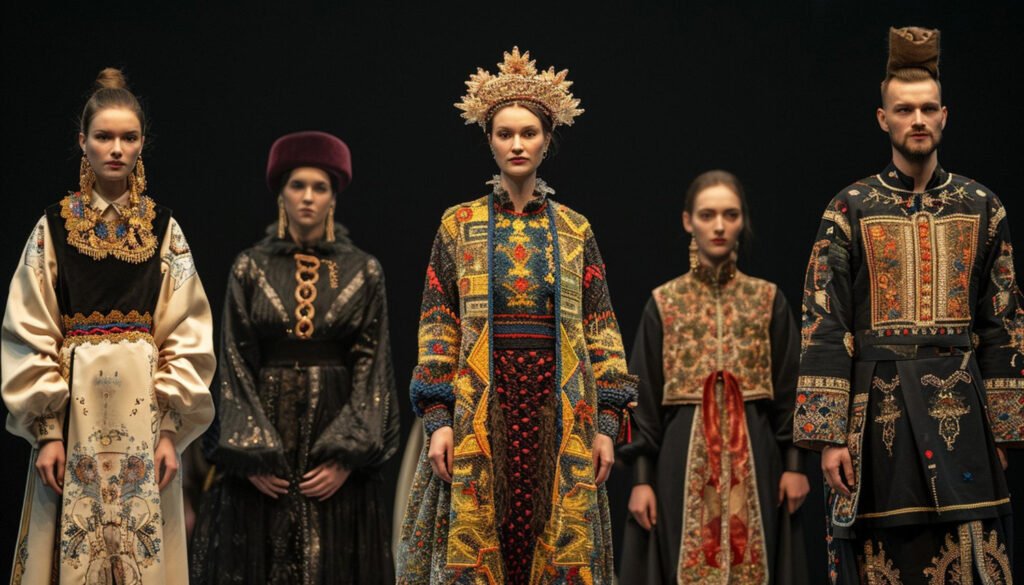
For thousands of years, clothing was a matter of life or death. If you didn’t wrap yourself in furs during the Ice Age, you froze. If you didn’t protect your skin from the blistering sun, you burned. It was a binary existence: covered meant safe; exposed meant vulnerable.
But at some point in our history, a shift occurred. A pelt wasn’t just a way to stay warm; it became a way to say, “I am a great hunter.” A necklace wasn’t just a collection of shells; it was a signal of trade, status, or belonging. We stopped dressing solely to survive the elements and started dressing to communicate with each other.
This transition—from function to fashion—is one of the most significant cognitive leaps in human history. It marks the moment we began to view ourselves not just as biological entities, but as social characters on a stage. It is the birth of identity.
The Prehistoric Shift: More Than Just Warmth
The popular image of the “caveman” involves a rough, shaggy loincloth and a club. While early humans certainly utilized animal hides for warmth, archaeological evidence suggests that our ancestors were far more stylish—and intentional—than we give them credit for.
The leap from pure utility to aesthetic expression likely began tens of thousands of years ago. We see the first glimmers of this in the archaeological record not through fabrics (which disintegrate over time) but through accessories and tools.
The Evidence of Decoration
Around 100,000 years ago, at Skhul Cave in Israel, humans were collecting Nassarius shells. These weren’t for eating; they were perforated to be strung into necklaces. This indicates that long before we had “fashion trends,” we had a desire to decorate our bodies.
Why does a shell necklace matter? because it serves no survival purpose. You cannot eat it, and it doesn’t keep you warm. Its only function is social. It signals to others that the wearer has the time, skill, or connections to acquire such an object. It is the prehistoric version of a luxury watch.
The Innovation of the Eyed Needle
Perhaps the most critical technological advancement in the history of fashion was the invention of the eyed needle, appearing around 60,000 years ago in Sibudu Cave, South Africa, and later in Europe during the Solutrean period (around 20,000 years ago).
Before the eyed needle, hides were likely tied or draped. With a needle, clothing could be fitted. Tailoring was born. A fitted garment is warmer, yes, but it also changes the silhouette of the body. It allows for complexity. Complex layering and stitching patterns meant that one group of humans could visually distinguish themselves from another based on the cut of their clothes.
The Introduction of Color
Then came color. In Dzudzuana Cave in Georgia, researchers found flax fibers dating back 30,000 years. The shocking discovery wasn’t just the fiber, but that the fibers had been dyed. Humans were using natural pigments to turn their garments black, gray, turquoise, and pink.
If clothing was purely for survival, natural flax would suffice. Dyeing requires effort, knowledge of chemistry, and time. The existence of dyed fibers proves that Paleolithic humans made aesthetic choices. They preferred pink over beige. They were styling themselves.
Ancient Civilizations: The Codification of Status
As humans moved from nomadic hunter-gatherer groups to settled agricultural societies, social structures became more rigid. Fashion became the primary tool for enforcing these hierarchies. In ancient civilizations, what you wore wasn’t just a suggestion; it was often the law.
Mesopotamia: The Kaunakes
In ancient Sumer, status was visually unmistakable. The garment of choice was the kaunakes, a skirt made of sheepskin with the wool still attached. As weaving technology advanced, they simulated this look with tufted wool fabric.
The length of the skirt determined your rank. Servants and soldiers wore short skirts for mobility. Royalty and high priests wore long, heavy, elaborate skirts that made physical labor impossible. This is a theme that repeats throughout fashion history: the higher your status, the less practical your clothing needs to be.
Egypt: The Art of Linen
In Ancient Egypt, the climate dictated the material—light, breathable linen—but the social hierarchy dictated the quality.
The Pharaohs and nobility wore linen so fine it was almost transparent, known as “royal linen.” They pleated their garments, a labor-intensive process that required the fabric to be pressed into ridges using a fixative. To wear a pristine, white, pleated linen robe in a dusty, hot environment was the ultimate flex. It showed you didn’t work in the fields and that you had servants to maintain your wardrobe.
Egyptians also heavily accessorized. While the clothing was simple, the jewelry was complex. Broad collars made of gold, lapis lazuli, and carnelian were not just beautiful; they were protective amulets. Fashion was spiritual.
Rome: The Power of Purple
Nowhere was fashion more politically charged than in Rome. The toga was the defining garment of the Roman male citizen, but you couldn’t just wear whatever toga you liked.
- Toga Virilis: Plain white wool, worn by adult male citizens.
- Toga Praetexta: White with a purple border, worn by magistrates and high priests.
- Toga Picta: Entirely purple with gold embroidery, reserved for victorious generals and later, Emperors.
The color purple (Tyrian purple) was extracted from the secretions of thousands of sea snails. It was exorbitantly expensive and smelled terrible during production, but the color was colorfast and vibrant. Laws were eventually passed—Sumptuary Laws—that legally forbade anyone but the Emperor from wearing a full purple toga. Fashion had become a state-controlled symbol of power.
The Renaissance Revolution: The Birth of the “Tailor”
While ancient civilizations used clothing to denote static rank, the concept of “fashion”—meaning a rapid change in style for the sake of novelty—really exploded during the Renaissance in Europe.
Before the 14th century, clothing styles changed very slowly. A peasant in 1100 AD dressed similarly to a peasant in 1200 AD. But as trade routes opened up and the merchant class grew wealthy, clothing became a way to compete.
The Fitted Silhouette
During the Middle Ages, clothes were generally loose and draped (tunics and robes). In the mid-14th century, a radical shift occurred. Men began wearing short, tight-fitting doublets and hose, revealing the shape of the leg. Women began wearing bodices that were laced tight to the torso.
This required a new level of craftsmanship. You couldn’t just weave a rectangle of cloth and drape it; you had to cut, shape, and sew fabric to follow the curves of the body. This demand gave rise to the professional tailor. Guilds were formed, and the secrets of pattern-making were guarded.
The Invention of Trends
It was during this era that we see the first evidence of “trends” moving through Europe. A style might originate in the Italian courts, travel to France, and eventually land in England.
The “slashed” style is a perfect example. After a battle in 1477, Swiss mercenaries repaired their tattered clothes with scraps of colorful fabric, or wore the looted finery of their enemies underneath their torn garments. The aristocracy saw this “shabby-chic” look and appropriated it. Suddenly, wealthy nobles were paying tailors to slice open their expensive velvet sleeves to pull valuable silk linings through the holes.
This was fashion for fashion’s sake. It was irrational, expensive, and purely aesthetic. It demonstrated that the wearer was plugged into the cultural current of the time.
The Industrial Age: Democratizing Style
For most of history, fashion was the exclusive playground of the ultra-rich. The poor had “clothes”; the rich had “fashion.” The Industrial Revolution shattered this divide.
The Sewing Machine and Mass Production
The invention of the sewing machine in the 19th century, along with the mechanical loom, changed the speed of production. Suddenly, fabric was cheaper. Garments could be assembled in a fraction of the time.
The rise of the “department store” in the mid-1800s (like Le Bon Marché in Paris) allowed the middle class to browse and purchase ready-made clothing. You didn’t need a personal tailor to look stylish anymore. You could buy a dress off the rack that mimicked the styles worn by royalty.
The Haute Couture vs. Ready-to-Wear
As mass production made clothing accessible, the elite needed a new way to distinguish themselves. Enter Charles Frederick Worth, the father of Haute Couture.
Worth was the first designer to put his name on a label sewn into the garment. He didn’t just take instructions from clients; he dictated the styles to them. He created the concept of the “fashion house” and the seasonal collection.
This created the “trickle-down” model of fashion that dominated the 20th century. Designers in Paris would show a collection; buyers and editors would view it; and within months, diluted versions of those styles would appear in department stores for the masses.
The Psychology of Dress: Why We Care
Why do we care so much? Why did a caveman drill a hole in a shell? Why did a Roman senator crave a purple stripe? Why do we spend hours scrolling for the perfect pair of sneakers?
Biologically, we are wired for signaling. In the animal kingdom, peacocks display feathers and frogs display bright colors to signal genetic fitness or toxicity. Humans, lacking biological ornamentation like bright feathers, created an artificial skin.
Enclothed Cognition
Psychologists use the term “enclothed cognition” to describe the influence that clothes have on the wearer’s psychological processes. It’s not just about how others see us; it’s about how we see ourselves.
A study showed that when subjects wore a white coat described as a “doctor’s coat,” their attention span increased. When the same coat was described as a “painter’s coat,” the effect vanished. We adopt the characteristics associated with what we wear.
Belonging and Individuality
Fashion serves two contradictory psychological needs simultaneously: the need to belong and the need to stand out.
- Belonging: We wear uniforms, team jerseys, or follow trends to show we are part of a tribe. It signals safety and cooperation.
- Individuality: We accessorize or choose niche brands to show we are unique, autonomous individuals.
The history of fashion is a constant negotiation between these two drives. The Punk movement of the 1970s used safety pins and torn clothes to rebel against the mainstream (individuality), but eventually, that “uniform” became a strict code for belonging to the Punk subculture (belonging).
The Future of Our Second Skin
From the first pierced shell in a cave in Israel to the digital fashion of the metaverse, our drive to adorn ourselves remains constant. The mediums change—we’ve moved from flax to polyester, from bone needles to 3D printers—but the motivation is ancient.
We dress to tell a story. We dress to manifest the version of ourselves we want the world to see. Fashion is not a frivolous pursuit; it is the oldest form of communication we have, one that speaks before we ever say a word.
Discover Your Own Style History
Understanding where fashion comes from helps us appreciate where it’s going. At [Brand Name], we believe that style is a journey, not a destination. Whether you’re looking for timeless staples that echo the classics or modern pieces that push the boundaries, we’re here to guide you.
Subscribe to our newsletter today to get weekly insights into fashion history, style tips from our experts, and exclusive access to our latest collections. Don’t just get dressed—get inspired.
Related Blog Topic:
| The History of Fashion: From Ancient Civilizations to Modern Trends — How Fashion Shaped Human Identity |
| From Survival to Style: How Fashion Began and Evolved Through Human History |


