


Fashion has existed for centuries—clothing adorned royalty, distinguished social classes, and expressed cultural identity long before modern runways and shopping malls. But fashion as we know it today—a sprawling, globalized industry worth trillions of dollars—didn’t emerge until relatively recently.
Understanding when and how fashion transformed from a craft into an industry requires examining key turning points: the shift from bespoke tailoring to mass production, the rise of iconic designers who commercialized creativity, and the technological revolutions that reshaped how we make, market, and consume clothing.
This exploration reveals not just the historical timeline of fashion’s industrialization, but also the forces that continue to shape what we wear and why we wear it.
Fashion vs. The Fashion Industry: What’s the Difference?
Before we trace the industry’s origins, it’s important to distinguish between fashion and the fashion industry.
Fashion refers to prevailing styles, trends, and ways of dressing that reflect cultural, social, and personal expression. People have been following fashion—wearing clothing that signifies status, profession, or aesthetic preference—since ancient civilizations.
The fashion industry, on the other hand, is the complex, organized system of designing, producing, marketing, and selling clothing on a commercial scale. It involves manufacturers, designers, retailers, marketers, and distribution networks working together to deliver garments to consumers efficiently and profitably.
The transition from one to the other marks a fundamental shift in how society produces and consumes clothing.
The Pre-Industrial Era: Tailoring and Dressmaking as a Craft
For most of human history, clothing was made by hand. Tailors, seamstresses, and dressmakers created garments individually for specific clients. Each piece was bespoke—custom-fitted and often unique.
Wealthy patrons commissioned elaborate outfits from skilled artisans who spent days or weeks crafting a single garment. The middle and lower classes either made their own clothing or purchased secondhand pieces. There were no standardized sizes, no catalogs, and certainly no concept of seasonal collections.
Guilds regulated the tailoring trade across Europe, controlling who could practice the craft and maintaining quality standards. This system prioritized skill and tradition over speed or scale. Fashion existed, but it wasn’t industrialized.
The Industrial Revolution: Mass Production and the Birth of Ready-to-Wear
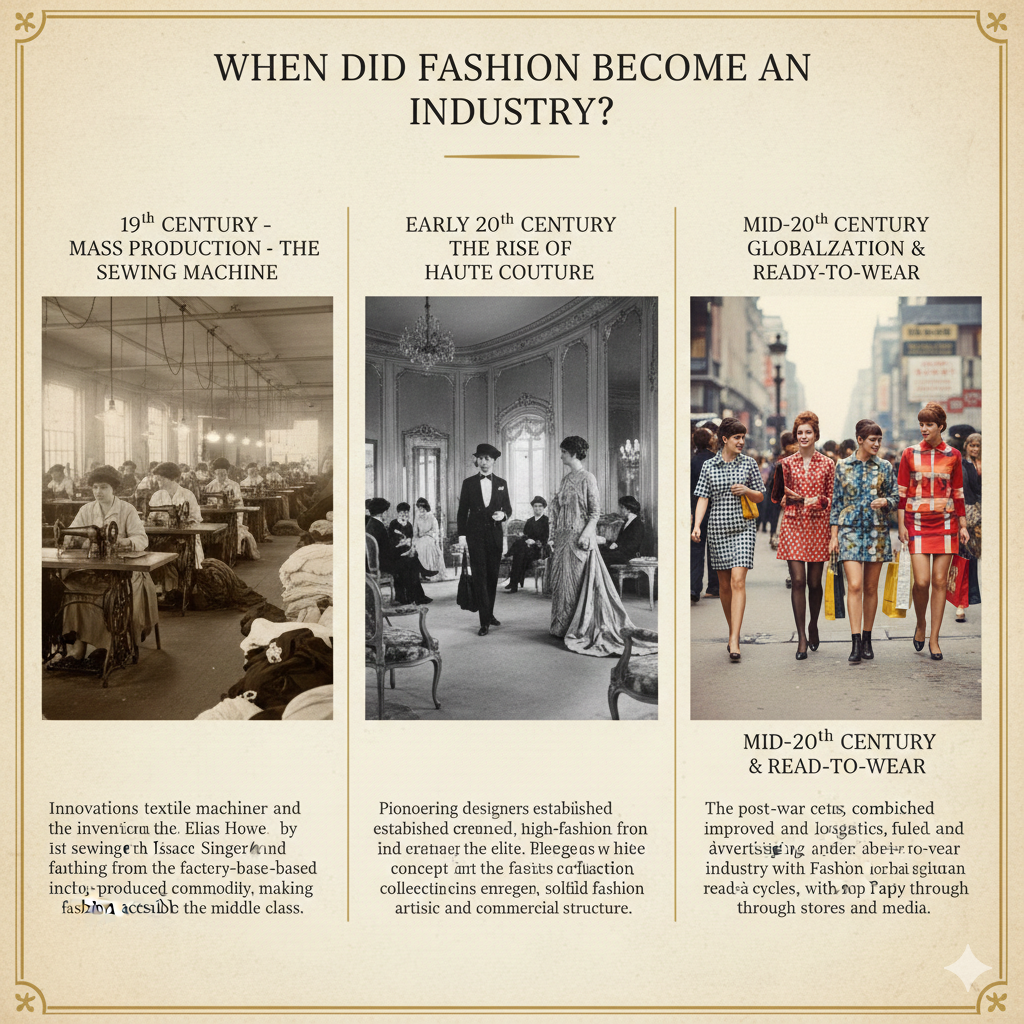
The Industrial Revolution of the late 18th and early 19th centuries changed everything. Mechanization transformed textile production first, with inventions like the spinning jenny and power loom dramatically increasing fabric output while lowering costs.
By the mid-1800s, the sewing machine revolutionized garment construction. Invented by Elias Howe in 1846 and improved by Isaac Singer in 1851, the sewing machine allowed workers to stitch fabric far faster than by hand.
This technological leap enabled the rise of ready-to-wear clothing—garments produced in standard sizes and sold off the rack. No longer did every piece need to be custom-made. Factories could now produce hundreds or thousands of identical items efficiently.
The concept of standardized sizing emerged during this period, although it remained imprecise for decades. Ready-to-wear appealed to the growing middle class, who wanted fashionable clothing without the expense of bespoke tailoring.
By the 1860s, ready-to-wear clothing was widely available in urban centers across Europe and North America. The fashion industry, as a manufacturing and retail enterprise, had begun to take shape.
Charles Frederick Worth: The Rise of Haute Couture in 19th-Century Paris
While mass production democratized fashion for everyday consumers, another development elevated it into an art form: the emergence of haute couture.
Charles Frederick Worth, an English designer working in Paris, is often credited as the father of haute couture. In 1858, he established the House of Worth, the first fashion house to operate as a brand rather than simply a tailor’s workshop.
Worth introduced several innovations that define the modern fashion industry. He created seasonal collections rather than waiting for individual commissions. He employed live models to showcase his designs. He attached labels to his garments, establishing the concept of designer branding.
Most significantly, Worth positioned the designer as an artist and tastemaker rather than merely a skilled craftsperson. His clients didn’t tell him what to make; he told them what to wear. This shift in power dynamics transformed fashion design into a creative profession with cultural authority.
Haute couture became synonymous with Paris, and other designers soon followed Worth’s model. Fashion houses like Doucet, Paquin, and later Chanel and Dior built empires around exclusive, high-end garments that set trends for the broader market.
The industry now had two tiers: luxury couture for the elite and ready-to-wear for the masses. Both would continue to grow and influence each other throughout the 20th century.
20th Century Expansion: Department Stores, Global Branding, and Marketing
The 20th century saw the fashion industry expand into a truly global phenomenon. Several developments accelerated this growth.
Department stores emerged as fashion destinations, offering a curated selection of clothing, accessories, and beauty products under one roof. Stores like Macy’s, Harrods, and Galeries Lafayette became cultural institutions, shaping consumer tastes and making fashion accessible to a wider audience.
Global branding took off as designers and retailers recognized the value of a recognizable name. Coco Chanel, Christian Dior, Yves Saint Laurent, and others became household names. Their logos and signatures signaled quality, status, and style.
Fashion magazines and advertising played a crucial role in promoting these brands. Publications like Vogue, Harper’s Bazaar, and Elle showcased the latest collections, taught readers how to dress, and created desire for specific products. Fashion photography became an art form in its own right.
The post-World War II era brought economic prosperity and a consumer culture that embraced fashion as a form of self-expression. Youth movements, subcultural styles, and celebrity influence all contributed to an ever-changing landscape of trends.
By the late 20th century, fashion had become a multi-billion-dollar industry, with complex supply chains spanning multiple continents. Designers showed collections in Paris, Milan, New York, and London. Retailers operated globally. Manufacturing shifted to countries with lower labor costs.
Fashion was no longer just about clothing—it was about lifestyle, identity, and aspiration.
The Digital Age: Fast Fashion, E-Commerce, and the Modern Supply Chain
The late 20th and early 21st centuries introduced another seismic shift: digitalization and the rise of fast fashion.
Fast fashion brands like Zara, H&M, and Forever 21 perfected a model that could take a design from concept to store shelves in a matter of weeks. They monitored trends constantly, produced garments quickly and cheaply, and refreshed their inventory at a dizzying pace.
This approach relied on highly efficient global supply chains, often involving factories in countries like Bangladesh, Vietnam, and China. The model prioritized speed and low cost over sustainability or ethical labor practices, sparking ongoing debates about the true cost of cheap clothing.
E-commerce transformed how consumers shop. Online retailers like ASOS, Boohoo, and Amazon Fashion offer vast selections with the convenience of home delivery. Social media platforms like Instagram and TikTok became powerful marketing tools, enabling brands to reach consumers directly and influencers to shape trends in real time.
Technology continues to reshape the industry. Digital fashion shows, virtual try-ons, AI-driven trend forecasting, and blockchain-based authentication are just a few innovations changing how fashion operates.
Sustainability has also become a central concern. As awareness of fashion’s environmental impact grows, consumers and brands are exploring alternatives: circular fashion, resale platforms, eco-friendly materials, and transparent supply chains.
The fashion industry remains in flux, adapting to new technologies, shifting consumer values, and global challenges.
The Future of Fashion: A Global Economic Powerhouse
Fashion is now one of the largest industries on the planet, generating trillions of dollars annually and employing millions of people worldwide. It influences culture, drives economic growth, and reflects societal values.
Yet the industry faces significant challenges. Environmental degradation, labor exploitation, overproduction, and waste all demand urgent attention. The COVID-19 pandemic exposed vulnerabilities in global supply chains and accelerated shifts toward digital retail.
Brands and consumers alike are rethinking what fashion should be. Slow fashion movements advocate for quality over quantity. Rental and resale models challenge the traditional ownership paradigm. Technology offers tools for more sustainable and personalized production.
Fashion’s transformation from craft to industry took centuries, driven by technological innovation, economic forces, and cultural shifts. Its future will be shaped by how it responds to the ethical, environmental, and social imperatives of our time.
Explore the Evolution of Fashion with Us
The journey from handmade garments to a globalized industry is a story of creativity, commerce, and change. If you’re fascinated by fashion history and want to dive deeper into the forces shaping what we wear, subscribe to our newsletter for more insights, analysis, and stories from the world of fashion.
Stay curious, stay informed, and discover the threads that connect our past to our present.
Related post:


