


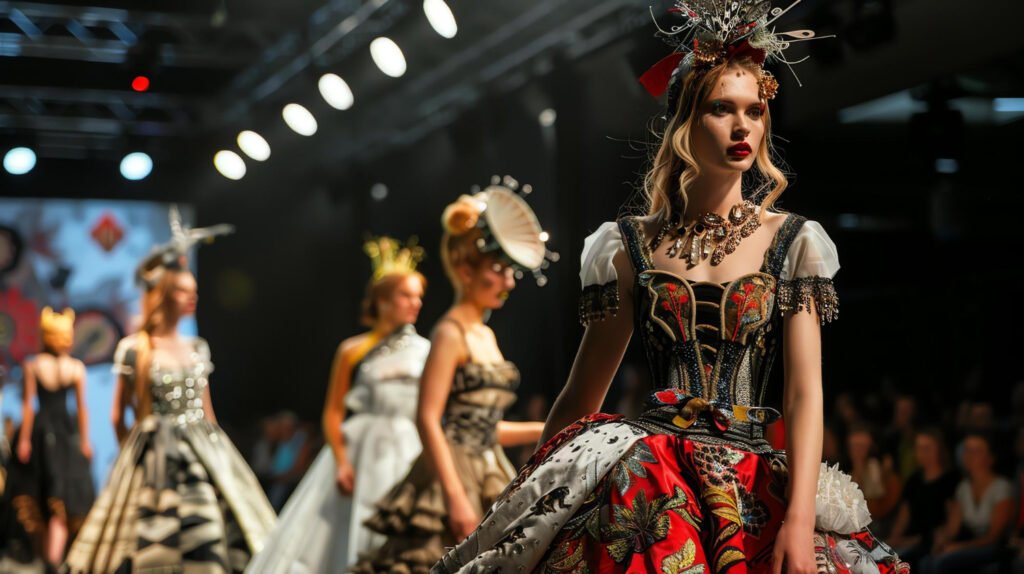
Clothing is a universal human experience, yet it is so much more than just a necessity for warmth or modesty. It is a language, a political statement, an art form, and a reflection of the society that wears it. From the animal hides of the Paleolithic era to the digital garments of the metaverse, the story of fashion is the story of humanity itself.
Every hemline, fabric choice, and silhouette tells us something about the people who came before us. What did they value? How did they live? Who did they aspire to be? To understand where fashion is going—with its current obsessions with sustainability and technology—we must first look back at where it began. This exploration isn’t just about clothes; it’s about the evolution of culture, technology, and identity woven into the fabric of history.
The Fabric of Survival: Historical Origins
Long before there were runways or boutiques, there was simply the need to survive. The earliest evidence of clothing dates back roughly 170,000 years, coinciding with the second-to-last ice age. Early humans used what was available to them—animal hides, furs, and grasses—draped and tied around the body to protect against the elements.
However, the real revolution happened with the invention of the eyed needle, created from bone or antler around 60,000 years ago. This tiny tool allowed for sewing, which meant clothes could be tailored to fit the body, providing better insulation and mobility. It was the first step from “covering” to “clothing.”
The Birth of Textiles
As human societies moved from nomadic lifestyles to settled agricultural communities, the materials used for clothing shifted dramatically. Weaving technologies emerged independently across different civilizations:
- Ancient Egypt: Known for its mastery of linen. The hot climate demanded light, breathable fabrics, and Egyptians cultivated flax to create linen so fine it was sometimes translucent.
- China: The birthplace of silk. Sericulture (silk farming) was a guarded secret for centuries, creating a fabric that became a currency and a status symbol across the ancient world.
- The Andes & Mesopotamia: Wool was a staple here, spun from the fleece of domesticated animals like sheep and alpacas.
These early textiles were not just functional; they were indicators of status. In many ancient societies, the quality of the weave and the color of the dye (like the famous Tyrian purple derived from sea snails) strictly separated the rulers from the commoners.
The Evolution of Silhouette: Renaissance to the Industrial Revolution
As civilizations advanced, fashion became less about survival and more about expression and hierarchy.
The Renaissance: Art in Motion
The Renaissance period (14th-17th century) marked a distinct shift where fashion became a pursuit of beauty and excess. Clothing was heavy, elaborate, and restricting. For the wealthy, it was about displaying opulence through velvets, brocades, and silks imported from the East.
This era introduced extreme silhouettes. Women wore corsets and farthingales (hoop skirts) to create artificial shapes that defied anatomy. Men weren’t exempt from this peacocking; they wore padded doublets, hose, and codpieces. Fashion was a spectacle, intended to take up space and demand attention.
The Baroque and Rococo: Exaggeration and Ornamentation
Moving into the 18th century, particularly in France, fashion became synonymous with the French court at Versailles. Under Louis XIV and later Marie Antoinette, style was characterized by pastel colors, intricate floral patterns, and towering hairstyles (poufs). It was a period of theatricality, where the artificiality of the look was the point.
The Industrial Revolution: Democratizing Style
The 19th century brought the most significant game-changer in fashion history: the Industrial Revolution. The invention of the sewing machine and the mechanical loom shifted production from the home (or the tailor’s shop) to the factory.
Suddenly, fabric was cheaper and faster to produce. Ready-to-wear clothing began to emerge, meaning that fashionable styles were no longer the exclusive domain of the aristocracy. The middle class could now emulate the trends of the upper class, albeit with cheaper materials. This era also standardized men’s fashion into the suit—a utilitarian, sombre uniform that reflected the new industrial work ethic, a style that has remained remarkably consistent for nearly two centuries.
The Rise of Haute Couture and 20th-Century Icons
While mass production was changing how the world dressed, a counter-movement emerged in Paris that would define luxury for the next century: Haute Couture.
The Father of Couture
Charles Frederick Worth, an Englishman working in Paris in the mid-19th century, is credited as the father of Haute Couture. Before Worth, dressmakers visited client’s homes and did as they were told. Worth turned the tables: customers came to his maison, and he dictated the design. He was the first to sew his name into garments, inventing the designer label.
The 20th Century: A Century of Change
The 1900s saw fashion move at breakneck speed, mirroring the rapid societal changes of the era.
- 1920s: Coco Chanel liberated women from the corset. The Flapper era introduced shorter hemlines, looser silhouettes, and jersey fabrics, reflecting women’s winning the right to vote and entering the workforce.
- 1940s: Christian Dior introduced the “New Look” in 1947. After the austerity and fabric rationing of WWII, Dior celebrated with cinched waists and voluminous skirts, reintroducing opulence.
- 1960s: The youthquake. For the first time, fashion was driven by teenagers rather than adults. Mary Quant popularized the miniskirt, and London’s Carnaby Street became the center of the fashion universe.
- 1970s & 80s: Yves Saint Laurent gave women “Le Smoking” (the tuxedo suit), blurring gender lines. Meanwhile, the 80s brought power dressing, with Armani and Versace defining a silhouette of broad shoulders and bold confidence for the corporate age.
Modern Trends: Street Style, Fast Fashion, and Sustainability
Entering the 21st century, the top-down model of fashion—where designers dictate trends to the masses—began to fracture.
The Street Style Revolution
The rise of the internet and social media democratized fashion influence. Blogs like The Sartorialist and later Instagram changed the focus from the runway to the sidewalk. Brands like Supreme and Off-White bridged the gap between skate culture and luxury, making hoodies and sneakers as coveted as Birkin bags. This “high-low” mix is the defining aesthetic of our current time.
The Fast Fashion Dilemma
The Industrial Revolution started mass production, but the late 90s and 2000s supercharged it into “Fast Fashion.” Retailers like Zara, H&M, and Shein condensed the production cycle from months to weeks.
While this allowed consumers to buy trends instantly and cheaply, it came at a high cost. The environmental impact is staggering: the fashion industry is responsible for up to 10% of global carbon emissions. The human cost, highlighted by tragedies like the Rana Plaza collapse in 2013, exposed the poor working conditions behind cheap garments.
The Sustainable Shift
In response to the fast fashion crisis, a powerful sustainability movement has emerged. Consumers, particularly Gen Z, are demanding transparency.
- Circular Fashion: The idea that clothes should never end up in a landfill. This includes the booming resale market (platforms like Depop and The RealReal) and rental services (Rent the Runway).
- Slow Fashion: A return to the pre-industrial mindset of buying fewer, higher-quality items.
- Material Innovation: Scientists are developing leather made from mushrooms (mycelium), fabrics from orange peels, and lab-grown silk to reduce reliance on resource-heavy cotton and petroleum-based synthetics.
Fashion as Cultural and Artistic Expression
It is a mistake to dismiss fashion as frivolous. Throughout history, it has been a vehicle for resistance and identity.
Consider the “Zoot Suits” of the 1940s, worn by Black and Latino men as a statement of defiance against racial prejudice. Look at the punk movement of the 70s, where safety pins and ripped clothes were a visual anarchy against the British establishment. Or consider the role of traditional dress—like the Japanese Kimono or the Indian Saree—which serves as a visual link to heritage in a globalized world.
Museums have finally recognized this. The Costume Institute at the Metropolitan Museum of Art (home of the Met Gala) treats garments with the same reverence as oil paintings. Exhibitions like Alexander McQueen: Savage Beauty proved that fashion evokes deep emotional responses, functioning as performance art just as much as commerce.
Future Outlook: Digital Fashion and Technology
So, where do we go from here? The next frontier of fashion might not be physical at all.
The Metaverse and Digital Skins
As we spend more of our lives online, our digital avatars are becoming as important as our physical bodies. “Digital fashion” allows users to purchase clothing that exists only in pixels. Brands like Gucci and Balenciaga are already selling skins in games like Roblox and Fortnite.
This solves a unique problem: the desire for “newness” for social media without the environmental waste of physical production. You can wear a gravity-defying dress of fire for an Instagram photo without a single thread being spun.
Tech-Integrated Clothing
In the physical realm, wearable technology is moving beyond the Apple Watch. We are seeing the development of “smart textiles”—fabrics that can monitor health biometrics, change color based on temperature, or even charge our devices. The jacket of the future won’t just keep you warm; it will interact with your environment.
The Thread Continues
From the bone needle to the 3D printer, fashion remains a mirror of the human condition. It documents our technical prowess, our social struggles, and our endless desire to reinvent ourselves. Whether we are wearing a thrifted vintage coat, a fast-fashion tee, or a digital skin in a virtual world, we are all participating in a millennia-old tradition of self-expression.
Fashion is never finished. It is always becoming.
Related blog topic:


