



U.S. Figure Skating Stars Practice at Milan-Cortina Olympics
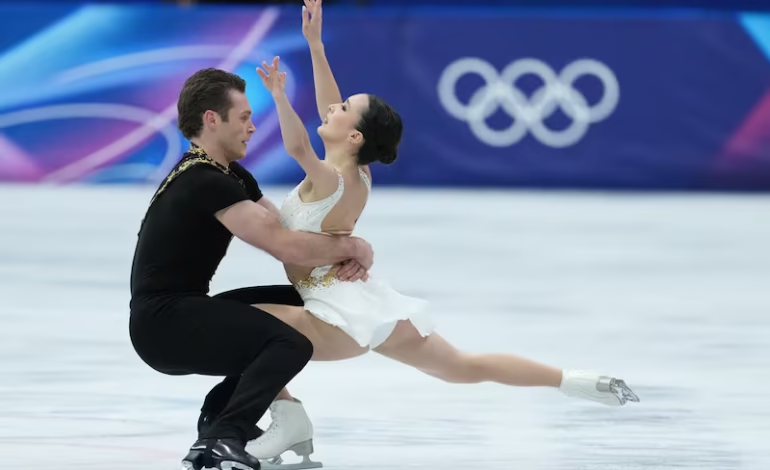

The Olympic cycle is a relentless machine. The moment the closing ceremony fireworks fade, the clock resets for the next quadrennial. For U.S. Figure Skating, the sights are already firmly set on Italy. The upcoming Milan-Cortina Winter Games represent more than just another competition; they mark a pivotal era of transition and dominance for American skaters.
With the Beijing Games in the rearview mirror, the landscape of the sport has shifted dramatically. New scoring emphases, retiring legends, and the meteoric rise of technical wizards have changed the calculus for gold. The U.S. team is currently navigating this complex terrain, balancing the need for athletic revolution with the artistic integrity the sport demands.
The journey to the podium in Milan is not paved with ice alone. It requires strategic planning, rigorous mental conditioning, and an understanding of a rapidly evolving global field. As the countdown to 2026 begins, Team USA is blending veteran leadership with explosive young talent to build a roster capable of sweeping medals across all four disciplines.
The New Guard: America’s Olympic Prospects
The strength of the U.S. program has always been its depth, and this cycle is no exception. However, the names on the roster are changing. We are witnessing a generational hand-off that is both exciting and nerve-wracking for fans. The team heading to Italy will look significantly different from the one that competed in 2022, defined by skaters who are pushing the physical boundaries of human capability.
The “Quad God” and the Men’s Field
Leading the charge is undoubtedly Ilia Malinin. Known globally as the “Quad God,” Malinin has single-handedly rewritten the physics of figure skating. By successfully landing the quadruple axel in competition—a feat previously thought impossible—he has established himself as the gold medal favorite.
But Malinin’s journey to Milan isn’t just about jumping. His recent training has focused heavily on component scores—the artistic side of skating. To secure Olympic gold, he cannot rely solely on technical prowess. His coaching team is refining his edge quality, musical interpretation, and spins to ensure he is a complete package. If he stays healthy, he is the titan the rest of the world must chase.
Behind Malinin, the U.S. men’s field remains robust. Skaters like Jason Brown, continuing to defy age with unmatched artistry, and rising stars like Camden Pulkinen are fighting for the remaining spots. Their challenge is to prove that American skating is about more than just quadruple jumps; it is about the mastery of the blade.
The Battle for the Women’s Podium
The women’s discipline has seen a resurgence in American competitiveness. Isabeau Levito has emerged as the standard-bearer for U.S. ladies. Known for her exquisite lines and balletic style, Levito offers a stark contrast to the power-jumping dominance often seen in recent years. Her path to Milan involves stabilizing her jumps while maximizing her already high artistic scores.
Chasing her is Amber Glenn, the current U.S. champion, whose powerful triple axel gives her a technical ceiling that few can match. The rivalry between Levito’s grace and Glenn’s power pushes both skaters to improve. For the U.S. women to break onto the Olympic podium in Milan, they will need to execute flawless programs to challenge the technical consistency of the Japanese and Korean teams.
Ice Dance and Pairs: A Legacy to Uphold
Ice Dance has long been a fortress for Team USA. With the veteran team of Madison Chock and Evan Bates leading the way, the U.S. continues to set the standard for storytelling on ice. However, the field is deepening. Teams like Christina Carreira and Anthony Ponomarenko are stepping up, proving that the pipeline of talent is secure.
The pairs discipline faces a steeper climb. Following the retirement of world champions Alexa Knierim and Brandon Frazier, the U.S. is in a rebuilding phase. New partnerships are forming, and the focus for Milan is on building chemistry and consistency. The goal is to develop a team capable of breaking into the top five globally, a difficult task against the established European and Canadian powerhouses.
conquering Italian Ice: Venues and Variables
Competing in Italy offers a unique set of variables. The figure skating events for the 2026 Games will primarily take place in Milan, a city with a rich fashion and artistic history. This cultural backdrop often influences the atmosphere of the event, rewarding programs that exhibit high style and sophistication.
The Forum di Assago
The likely venue, the Forum di Assago (now known as the Unipol Forum), is a familiar stop on the international circuit, having hosted World Championships in the past. It is known for its energetic crowds and specific ice conditions. Veteran skaters often note that European ice can feel different—sometimes harder or more brittle—depending on the refrigeration systems and ambient humidity.
Adapting to the specific geometry and feel of the Milan rink will be a priority. U.S. Figure Skating officials are already analyzing logistical data to prepare athletes for the travel, the time difference, and the specific acoustics of the arena. Sound travels differently in every venue, affecting how skaters time their movements to music. Mastering the sensory environment of the Forum will be crucial for those hoping to deliver peak performances.
The Cortina Connection
While the skating happens in Milan, the “Cortina” half of the Olympic title influences the spirit of the Games. The dual-city nature of these Olympics creates a logistical challenge, separating the ice sports from the alpine events. This separation can impact team morale, as the “Olympic Village” experience is split. Team USA is prioritizing team-bonding camps ahead of the games to ensure that despite the physical distance between venues, the athletes feel the support of a unified delegation.
Global Rivals: Where the U.S. Stands
To win gold, you must beat the best. The geopolitical landscape of figure skating has shifted, and identifying the main rivals is key to the U.S. strategy.
The Japanese Powerhouse
Japan remains the most formidable obstacle to U.S. dominance in the singles disciplines. In the men’s field, Yuma Kagiyama and Shoma Uno (if he continues) possess a blend of soft knees and deep edges that judges adore. Their reliability puts immense pressure on U.S. skaters to skate clean. In the women’s field, Kaori Sakamoto has been an unstoppable force, winning consecutive World titles with powerful, flowing skating that scores massively in grades of execution (GOE).
The European Resurgence
In Europe, France has re-emerged as a titan, particularly with Adam Siao Him Fa in the men’s event. His avant-garde style and athletic explosive power rival Malinin’s. Furthermore, the Italian team will have the home-field advantage. Skaters like Daniel Grassl (pending eligibility) and their strong ice dance teams will be buoyed by a raucous home crowd, potentially influencing the subjective components of the scoring.
The Canadian Challenge
Canada remains a perennial threat in Ice Dance and Pairs. Their top teams are technically sound and classically trained. The rivalry between North American neighbors is friendly but fierce, often decided by fractions of a point. The U.S. strategy against Canada relies on innovation—creating lifts and choreographic sequences that push the boundaries of the rules to gain a technical edge.
Tech vs. Art: The Evolution of Scoring
One of the biggest storylines heading into Milan-Cortina is the ongoing war between technical difficulty and artistic presentation. The International Skating Union (ISU) has tweaked the rules to ensure that figure skating does not become a jumping contest.
The Component Score Crackdown
Judges are being instructed to scrutinize “skating skills” more heavily. This involves the clarity of edges, the speed across the ice, and multidirectional skating. A skater can no longer rest between jumps; the choreography must remain complex throughout the entire four minutes.
This shift impacts the U.S. training regimen significantly. Athletes are spending more time with choreographers and movement coaches than ever before. For a jumper like Ilia Malinin, this means ensuring that the transitions into and out of his quadruple jumps are seamless, not static.
The Risk of the Quad
While the quad axel and quad lutz earn massive points, they carry massive risks. A fall not only hurts the technical score but also caps the component score. The strategy for Milan is “calculated risk.” U.S. coaches are using data analytics to determine the optimal layout for programs—deciding when it is statistically better to attempt a difficult quad versus a clean triple that earns high grades of execution.
The Road Ahead: Qualifying and Key Dates
The path to Milan is a marathon, not a sprint. The next two years are critical for earning quota spots and establishing pecking orders.
The Grand Prix Series
The annual Grand Prix series serves as the testing ground. Skaters travel to six countries to qualify for the Grand Prix Final. Success here establishes a skater’s reputation with international judges. Consistency across the Grand Prix circuit is often the best predictor of Olympic success.
World Championships
The World Championships preceding the Olympics are the most vital event. This is where countries earn their Olympic spots. The U.S. must place highly—typically having two skaters finish with a combined placement of 13 or lower—to earn the maximum of three spots per discipline. The pressure at these Worlds is often higher than at the Olympics themselves, as a bad skate here can shrink the entire team size for 2026.
U.S. Nationals
Finally, the U.S. Championships serve as the final selection event. Often held just weeks before the Games, this is the pressure cooker where dreams are realized or shattered. The selection committee looks at the body of work, but the performance at Nationals is the final argument a skater makes for their ticket to Italy.
The Countdown Has Begun
As the winter seasons roll on, every lutz, every spin, and every step sequence brings Team USA closer to the opening ceremony in Milan. The athletes are refining their craft, battling injuries, and pushing the artistic envelope to ensure that when they step onto the Italian ice, they are ready to seize the moment.
The blend of Ilia Malinin’s gravity-defying jumps, Isabeau Levito’s artistic elegance, and the veteran poise of the ice dance squad makes this one of the most exciting American teams in history. They aren’t just training to participate; they are training to dominate.
For fans, the narrative is just beginning to take shape. The rivalries are heating up, the programs are being polished, and the dream of gold is becoming a tangible reality.
Stay on the Inside Edge
Don’t miss a single axel or artistic breakthrough on the road to Milan-Cortina 2026. Subscribe to our newsletter today for exclusive interviews with Team USA athletes, behind-the-scenes looks at their training camps, and real-time updates on the qualifying competitions. Join the community and cheer our skaters to victory!